Same $269, Two Very Different Bets
At exactly $269, the Elegoo Mars 5 Ultra and the Anycubic Photon Mono M7 are priced identically. That’s where the similarity ends. The Mars 5 Ultra is a compact, beginner-friendly machine with a 7-inch 9K screen and automatic leveling. The Photon Mono M7 is a larger, more capable printer with a 10.1-inch 14K screen and a build volume that’s nearly three times bigger — but it still uses manual leveling in 2026, which is a real concession to ask of anyone spending $269.
The central question isn’t which printer is “better.” It’s whether you need the M7’s extra volume and resolution badly enough to deal with its friction points. If you’re printing one or two minis at a time on a small desk, the Mars 5 Ultra is a cleaner experience. If you’re running batch prints or need the sharpest possible pixels for jewelry or competition-level miniatures, the M7 earns its footprint.
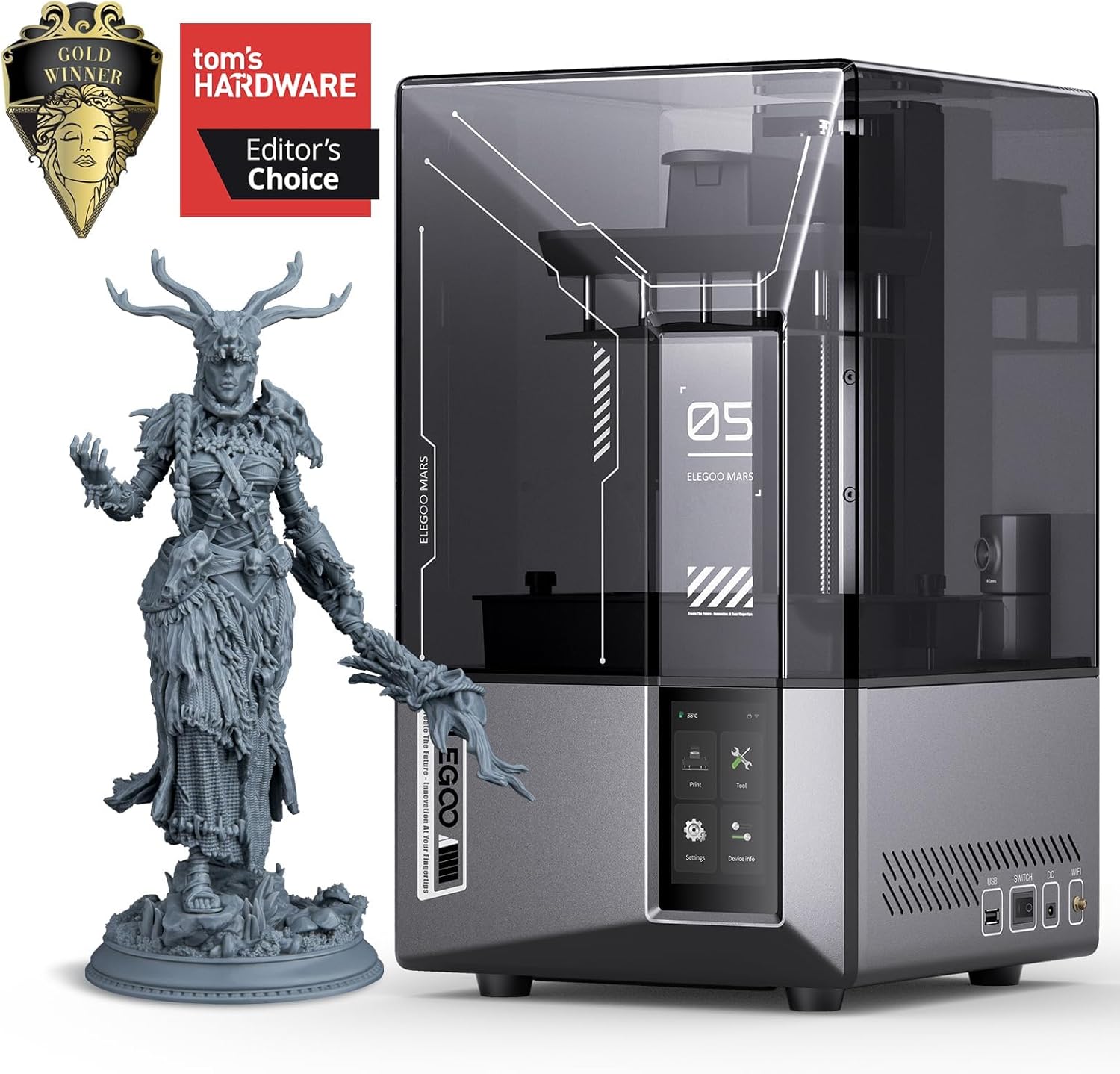
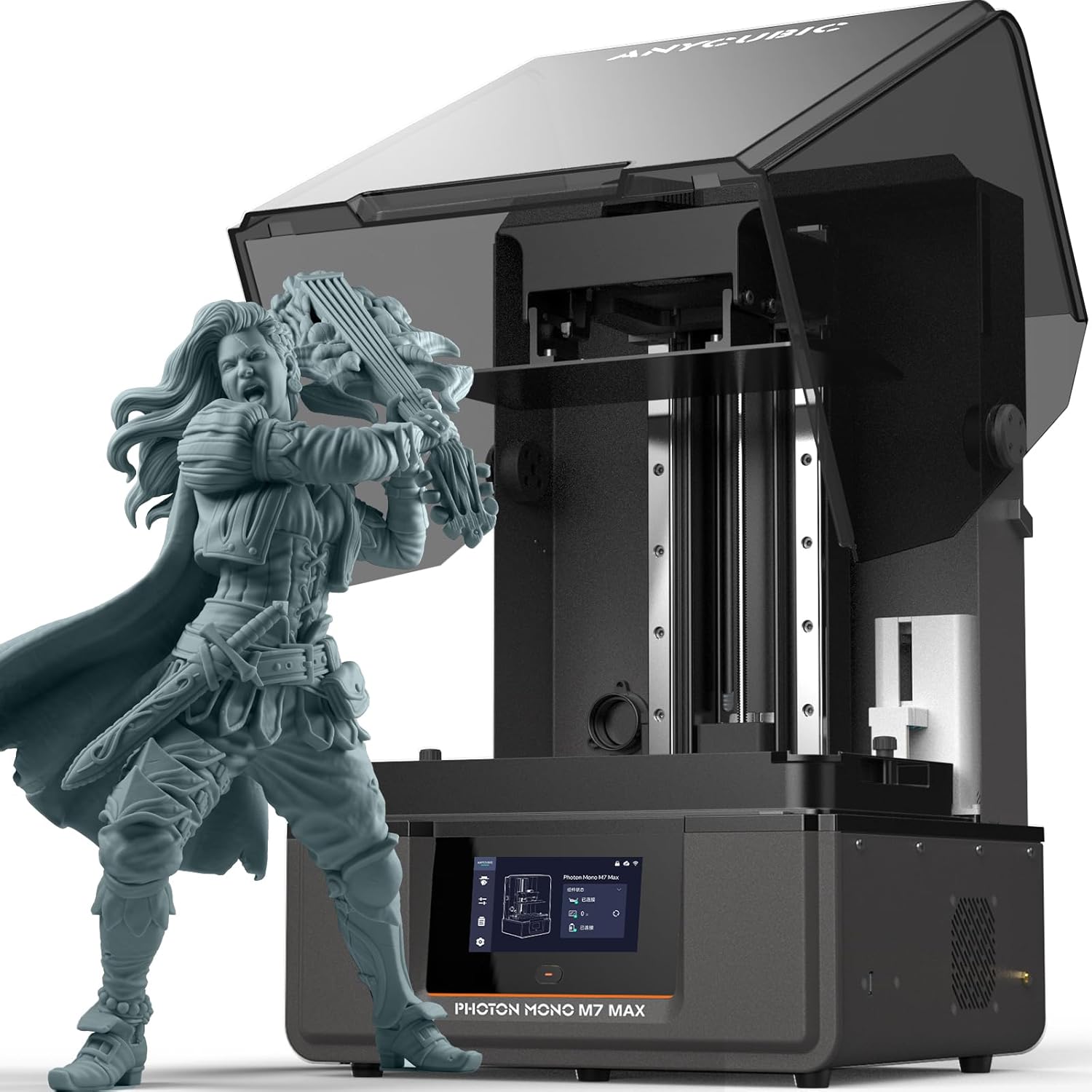
| Spec | Elegoo Mars 5 Ultra | Anycubic Photon Mono M7 |
|---|---|---|
| Build Volume | 153.36×77.76×165mm | 223.78×126.97×230mm |
| LCD | 7 inch mono | 10.1 inch mono |
| Resolution | 9K (8520 x 4320) | 14K (13312 x 5120) |
| XY Resolution | 18 µm | 17 µm |
| Light Source | COB UV | Anycubic LighTurbo (matrix LED) |
| Release Film | nFEP | Improved ACF Film |
| Leveling | Automatic | Manual (4-screw) |
Build Volume: Small Desk vs. Serious Output
The Mars 5 Ultra’s build plate is 153 × 78 × 165mm. That’s enough for a 32mm miniature with room for supports, or a small cluster of tokens and terrain pieces. It’s a deliberate form factor — the whole printer fits comfortably next to a wash-and-cure station on a standard desk without dominating the space.
The Photon Mono M7 is a different category of machine. Its build volume is 224 × 127 × 230mm — more than double the Mars 5 Ultra’s footprint in X and Y, and 65mm taller in Z. That means you can print a full squad of 28mm infantry in a single run, or a large bust, or multiple jewelry prototypes side by side. If your workflow involves batch printing, the M7’s plate isn’t just convenient — it changes how you plan your print queue entirely.
The tradeoff is physical: the M7 is a bigger machine that needs more desk space, more resin per vat fill, and more wash solution to clean a full plate. If you’re printing one-offs or testing resin for the first time, that overhead is unnecessary.
Resolution and Screen: 9K vs. 14K
Both printers use monochrome LCD panels with COB or matrix UV light sources, and both hit a 10µm minimum layer height. At that level, they’re comparable. Where they diverge is XY pixel size.
The Mars 5 Ultra’s 9K panel (8520 × 4320) delivers 18µm pixels. The Photon Mono M7’s 14K panel (13312 × 5120) delivers 17µm pixels — and Anycubic notes these are non-square at 16.8 × 24.8µm, which matters slightly for how fine diagonal lines render.
In practice, 18µm vs. 17µm is not a difference you’ll see with the naked eye on a 32mm miniature. Both printers will reproduce chainmail, facial features, and fine text on bases with impressive fidelity. The gap becomes relevant when you’re printing jewelry masters or competition display pieces where every micron of surface quality counts, or when you’re printing at the M7’s larger scale and need that resolution to hold across a bigger plate.
The M7’s LighTurbo matrix LED system is worth noting separately. Uniform exposure across a large LCD panel is genuinely hard to achieve, and uneven light sources cause the edges of a print to cure differently than the center. Anycubic’s LighTurbo addresses this directly, and it shows in edge-to-edge consistency on full-plate prints. The Mars 5 Ultra’s COB UV source is solid for its screen size, but the M7’s larger panel makes even illumination a harder engineering problem — and LighTurbo solves it well.
Leveling: Auto vs. Four Screws
This is the sharpest practical difference between these two printers, and it’s the one most likely to affect your daily experience.
The Mars 5 Ultra uses automatic leveling. You home the plate, run the leveling routine, and print. No paper, no feeler gauge, no four-screw dance. For a beginner, this removes the single most common failure mode in resin printing: a plate that’s slightly off-level causing the first layers to delaminate or the print to peel off mid-run.
The Photon Mono M7 uses manual 4-screw leveling. This is a well-understood process — tighten the screws evenly with a piece of paper under the plate, lock it down, and you’re good for dozens of prints. Experienced resin printers do it in under five minutes. But it requires re-leveling when you swap plates, when the printer gets moved, or when something shifts. It’s also a real barrier for someone who’s never touched a resin printer before.
Anycubic has shipped auto-leveling on other machines. The M7 not having it at $269 in 2026 is a genuine omission, not a minor footnote. If you’re a beginner, this alone is a reason to look hard at the Mars 5 Ultra first.
Release Film: nFEP vs. ACF
The Mars 5 Ultra ships with a standard nFEP release film. It works well, but nFEP has a shorter service life than ACF — expect to replace it after a few hundred hours of printing, or sooner if you’re running abrasive or high-pigment resins. Replacement films are cheap and widely available, but it’s a maintenance step to plan for.
The Photon Mono M7 ships with Anycubic’s improved ACF (Anti-Crystal Film). ACF has lower peel force than nFEP, which reduces the stress on prints during the release cycle — particularly useful for thin parts and flexible resin. It also lasts longer under normal use. This is a meaningful upgrade, especially if you’re printing detailed miniatures where a high-force peel can snap fine spears or antennae.
Neither film type changes the fundamental resin compatibility — both printers handle the same range of resins at the same ratings. But ACF is the better long-term consumable, and the M7 ships with it standard.
Slicer and Ecosystem
Both printers connect via Wi-Fi and USB. Neither has a filament runout sensor (not applicable to resin) or intelligent print monitoring.
The Mars 5 Ultra works with Elegoo’s Chitubox-based workflow and is also compatible with third-party slicers like Lychee. Elegoo’s ecosystem is mature, and the Mars series has a large community of users sharing profiles and settings.
The Photon Mono M7 uses Anycubic’s own slicer, which has improved substantially over the past two years. It’s stable, has solid support generation, and handles the M7’s larger plate well. Anycubic also supports Chitubox and Lychee for users who prefer them.
Neither slicer is a reason to choose one printer over the other. Both ecosystems are functional and well-supported.
The Buy Recommendation
Buy the Elegoo Mars 5 Ultra (~$269) if:
- You’re new to resin printing and want the simplest possible setup experience
- You print single miniatures, small squads, or one-off parts — not full-plate batches
- Desk space is limited and you want a compact footprint
- You’d rather not deal with manual leveling re-checks after every plate swap
- You want a printer rated for beginners with a 5/5 ease score
Buy the Anycubic Photon Mono M7 (~$269) if:
- You batch-print miniatures, terrain, or jewelry prototypes and need the larger 224 × 127 × 230mm plate
- You want the sharpest available pixels at this price for competition or display-quality work
- You’ve leveled a resin printer before and manual leveling doesn’t bother you
- You value ACF film and LighTurbo’s even exposure over auto-leveling convenience
- You’re printing at scale and the Mars 5 Ultra’s build volume would bottleneck your workflow
For most people buying their first resin printer, the Mars 5 Ultra is the right call. Auto-leveling alone removes the most common beginner failure mode, and 18µm resolution is more than enough for any miniature work. The M7 is the better machine for experienced users who need the volume — but it asks more of you in return.
For a broader look at how these fit into the resin and FDM landscape for miniature printing, see our best 3D printers for miniatures roundup .